Tuesday, July 19, 2005


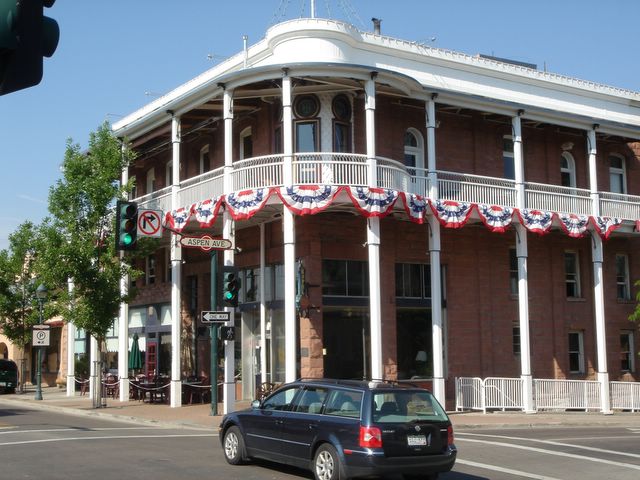
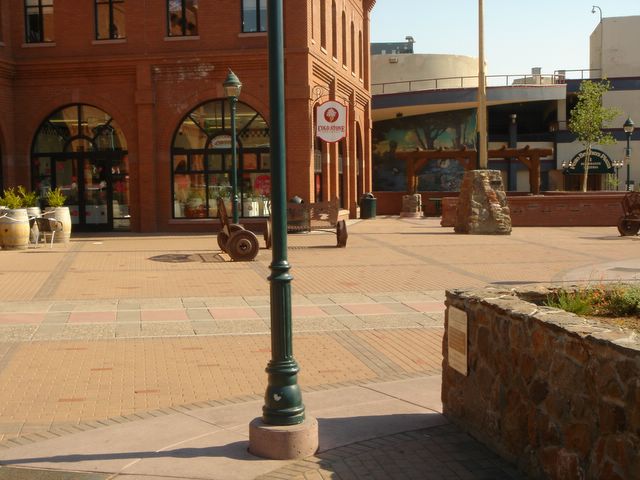
Heritage Square, Downtown Flagstaff, AZ Posted by Picasa

Downtown Hotel in Flagstaff, AZ Posted by Picasa

Me in Sedona, AZ Posted by Picasa

Community Owned Banks—Key Factor for Agurb® Success

“Small businesses with fewer than 500 employees account for approximately three-quarters of all new jobs created every year in this country,” was said by the Vice Chairman Reich of the FDIC recently in testimony before the US Senate. He went onto say, “The data indicates that community banks with less than $1 billion in assets, which hold only 14 percent of industry assets, account for 45 percent of all loans to small businesses and farms.”

One of the key factors that I look at in every agurb® that I visit, is the ownership of local financial institutions in the community. I’m found it to be a critical, determining factor between that teeter-totter of failure and success. Often, it is the local banker who is willing to financially back the entrepreneur starting a new business or the farmer expanding their operation that can help take a town to new levels of economic performance.

Oftentimes a banker will make a loan to a new entrepreneur, not based upon their net worth or collateral, but because they have seen them grow up in the town. They’ve observed how they’ve handled adversity, their integrity and general approach to life. It’s called “Character” and it used to be one of the most important, if not MOST important, criteria that a banker used to make a loan. Many small town bankers still do, but someone who is grading a loan proposal from an ivory tower for their branch bank can’t ever get a feel for that important C word.

Reich went onto say, “The loss of community institutions can result in losses in civic leadership, charitable contributions, and local investment in school and other municipal debt. I have a real concern that the volume and complexity of existing banking regulations, coupled with new laws and regulations, are increasingly posing a threat to the survival of our community banks.”

Monday, July 18, 2005

Funny Named Towns—Why, Why?

Today I was in Why, AZ, not a very impressive or big town, but definitely a uniquely named town. I’m collecting names of such towns as I travel around the USA.

Here are some that I’ve found so far: Elephant Butte, NM; Cheapskate, TX; Fertile, MN (why only 900 residents?); Arab, AL; Pumpkintown, SC; Cut-N-Shoot, TX; Tightwad, MO; Hot Coffee, MS; Pie Town, NM; Panic, PA; Knock-em-Stiff, OH; Gays, IL (celebrated their 150th sesquicentennial this past weekend); Hell, MI; and Ho-Ho-Kus, NJ. I’ve got dozens of others on my list and expect to add to it as I continue my travels. If you’ve got others, email them to me at jschultz@agracel.com.

If I was Why, I think that I’d change the sign a bit rather than as is shown on the following photo. What do you think?

Why Why, AZ? Posted by Picasa

Saturday, July 16, 2005

Making it in Rural America

On April 10th I wrote about Dakota Cabin Quilts (www.dakotacabinquilts.com), which is located in the small town of Hettinger, ND (population 1,300). This is the largest town for a 40 or 50 mile radius and you wouldn’t expect to find a world wide retailer there. But you would be wrong, because of the vision and determination of a young couple, Laura Walker and her husband Wes Cvach. They started a quilting company out of Laura’s hobby and today sell quilting supplies all over the world.

My wife just bought one of their “Oh My Stars” quilt kit. She has done dozens of quilts over the years and commented to me on the efficiency of dealing directly with Dakota Cabin thru their website.

Dakota Cabin Quilts is a great example of how entrepreneurs in rural USA are transforming business and doing it on a global basis.

Friday, July 15, 2005

Offshoring Numbers

“What are we going to do about all of these manufacturing jobs going overseas?” is probably one of the most frequently asked questions that I get after my talks. It is an emotional issue in many communities.

Here are the latest numbers that I’ve found in my research. We used to manufacture more than 90% of goods that we consumed in this country. Today it is down to 75%, still a fairly high percentage.

In the past year the USA economy added 15 million new jobs, while eliminating 13 million jobs for a net gain of over 2 million jobs. In the past five years from 135,000 to 250,000 jobs have been offshored each year. Doing the math, that is from 1 to 2% of the jobs that are lost each year. Not a very high percentage, unless you are one of those 1 or 2%.

China is often viewed as growing its manufacturing base at the expense of the USA. The two million American manufacturing jobs that have been lost are cited. Never mentioned is that China lost fifteen million manufacturing jobs during the same period of time.

The USA economy is a vibrant one. It creates new jobs and eliminates old ones. This vibrancy is what makes our economy the best in the world.

Thursday, July 14, 2005

Business Week Interview

I’m featured on Business Week Online today. Be sure to check out my interview at http://www.businessweek.com/smallbiz/index.html.

Team Agracel is having some fun with the “Prince of Hamlets.”

Hard Work U

A school that graduates 100% of their students without any college debt? We visited one of the places that make this possible on a stop for fuel on my trip to Bentonville.

The College of the Ozarks in Point Lookout, MO was founded in 1906 as a place that promoted the value of honest labor in conjunction with a good education. Anthony Ashley, a sophomore in Psychology and Travis Burgard, a senior who wants to become a missionary pilot, took care of us at the College’s airfield and FBO.

Anthony explained to me, “We work 15 hours/week during the semester, which pays for all of our tuition. It is required of everyone at the college. We work in landscaping, custodians, food service and other places. If we want we can work another 40 hours/week during the summer, which pays for all of our room and board.”

It is a different approach, but one that gives hard working students a way to get a great education and work experience without putting themselves into long term debt.

Wednesday, July 13, 2005

Bentonville’s Sense of Place

Bentonville has one of the nicer downtowns that I’ve seen in my travels. It houses Walton’s 5 & 10, Sam’s first dime store, right on the square. Arvest Bank, the Walton family’s bank holding company has redone the north side of the square with a small town feel for their headquarters.

Despite the success of their downtown, Bentonville started a Main Street program two years ago to continue to revitalize it. The Compton Gardens, a botanical garden project conceived and donated to the town by a family doctor in Bentonville who undoubtedly bought Wal-Mart stock early on, lies adjacent to the downtown. Earlier this year, Alice Walton, Sam’s only daughter, announced plans for Crystal Bridges, a multi-million dollar art museum. The Compton Gardens/Crystal Bridges complex will occupy 150 acres of land next to the downtown and improve an already impressive area.

My talk took place at NorthWest Arkansas Community College, a vibrant place that was only started in 1989. With 5,000+ students, it is already the second largest community college in the state. It offers typical community college classes but also specialized ones aimed at Wal-Mart employees and vendors.

This is not a town resting on its laurels. They are constantly pushing the edge of the envelope to continually make themselves a better town.

Tuesday, July 12, 2005

Reaching Out! To Regionalism!

Why would a booming town like Bentonville want to reach out to the surrounding area, is something that Rich Davis, Economic Development Director for the Bentonville/Bella Vista Chamber, is often asked. But Bentonville understands the importance of regionalism and is even going into the neighboring State of Missouri (McDonald and Berry Counties) to develop a regional approach.

It makes a lot of sense to me. Bentonville has an incredible economic engine that is sucking up workers at a rapid pace. Unemployment is less than 2%, an unheard of number for a town the size of Bentonville.

There are wonderful opportunities to tap into such new companies as contract manufacturing, warehousing and others that might not want to be directly in Wal-Mart’s backyard, but might want to be close by.

Bentonville first showed the power of cooperation when it joined with the Bella Vista Chamber to form a regional chamber. Now it is doing the same thing in economic development.

Smart town! But what would you expect in Sam’s hometown?

Monday, July 11, 2005

Stock Option Magic

What is the biggest change in Bentonville since Sam passed away in 1992, was a question that I asked to several people there during my talk and visit. To a person they all mentioned how there is more of a show of wealth, with new mansions being built, expensive cars purchased and other expenditures. “Sam would have never wanted that,” was told me by several.

And, if you look at the numbers you can understand how Wal-Mart has brought so much wealth to the small town. Sam was notorious for paying low wages but freely giving stock options to virtually everyone. The associates bought into the plan and hundreds, if not thousands reaped the rewards.

If you had bought stock in Wal-Mart at the time of their IPO in 1971 and held it to today, you would be a very wealthy individual. A $1000 investment would have purchased slightly over 60 shares. In the next 34 years the stock has split two-for-one eleven different times, which would have resulted in approximately 124,000 shares, worth $6 million.

I was told of former Wal-Mart employees who cashed in their stock options to buy houses, cars, etc. The most interesting was a fellow who bought a riding lawn mower with his options. He still has the riding lawn mower, but kicks himself today as the stock would be worth several million dollars. That is an expensive lawnmower!

Sunday, July 10, 2005

Google Search Shows Bubble

I’m sitting in a hotel room in rainy Atlanta this afternoon, catching up on my reading. I’ve been away from home a lot and have a big pile of items to read. I appear to be losing the competition as the piles at the office and home continue to grow. I caught up on some of the more important items on this trip.

One of my continuing concerns with our economy is the growing bubble that I see taking place in real estate. Several markets like LA, SF, Las Vegas, Phoenix and others have seen values increase dramatically. Today 31% of the total value of real estate in the USA is in the top 10 markets, compared to only 20% ten years ago. It reminds me of the mid 80s when the real estate under the Imperial Grounds in Tokyo had more value than the entire state of California. It didn’t make sense then and I don’t believe that the values in some of these markets make sense today.

I got on Google to do a couple of searches to see if there was some evidence of hype in real estate. When I typed in real estate I got 109,000,000 hits compared to 78,900,000 for sex; 61,000,000 for God; and 43,100,000 for stock market. Doesn’t that sound like a bubble to you?

Boomtown USA, at 243,000 hits on Google, lagged far behind those words, but we smoked exurbs at 29,400; boonyacks at 284; agurbs at 224 and supercalifragialistic at 5. No bubble yet for Boomtown!

Reminisces of Sam

Ed Clifford, Executive Director of the Chamber, started working for Wal-Mart as a buyer in 1984 when the company had $4 billion in sales, compared to $285 billion today. At the time Wal-Mart only had 2 Distribution Centers.

Sam Walton personally recruited him from Tulsa where he was working for a competitor. At the time Wal-Mart had 21 buyers and as Ed said, “Sam, would have liked to only have one. He hated overhead.”

He went onto tell me, “Sam hated technology but knew he had to use it. He never used a calculator. If he couldn’t do a calculation in his head, it wasn’t of importance to him.” It is ironic that Wal-Mart’s use of technology has been such a key driver in their growth. “Sam understood the importance of technology. He just didn’t like it. He wanted to open one store at a time and get a chance to meet everyone at the stores at least once a year.”

Saturday, July 09, 2005

Wal-Mart’s Hometown

I’ve been in Bentonville, AR, Wal-Mart’s hometown, a number of times in the past several years, but I’m always amazed at the growth that I see taking place, the new businesses opening their doors and the people moving to the area. Thirty years ago, Bentonville was an unknown little town that was considered “out in the middle of know-where.” Wal-Mart put it on the map and is still the driving force of growth, but others are being attracted to, the community. I spoke with several at my talk.

Jim & Michele Rinella lived most of their working lives in CA, working in agribusiness. They lived their last 11 years in Palm Desert, next to Palm Springs in the Coachella Valley. It is a faming, tourism and retirement area. Ag was always the backbone, but the influx of new residents drawn by the 100+ golf courses and other amenities were big plusses.

Even though they could have retired in Palm Desert or even in WA where they owned a second home, they did a nationwide search, researching retirement communities and traveling all over the USA. They concentrated their search in CA, AZ, WA and TX but read about AR. Jim did his military basic training at Ft. Chaffee in Ft. Smith, AR but hadn’t been in AR since those days. They routed one of their search trips thru AR and when they got to Bella Vista (right next to Bentonville) they fell in love with the area.

I asked them about adjusting to life in small town Arkansas. Jim told me, “It was tough at first. Retirement was a new thing for me. I didn’t get that adrenaline rush every morning like I did when I was running a business. But we’ve quickly adjusted.”

Michele explained, “We seemed to lack better dining options and shopping when we first got here, but it’s gotten a lot better in the five years that we’ve lived here. We used to make a lot of trips to Kansas City or Tulsa for our ‘big city fix’, but we don’t do that as much as we did at first.”

Lisa & Steve Lockwood are more recent Bentonville residents. They decided about a year ago that they wanted to move their space-planning consulting business (www.fa-strategies.com) from Minneapolis to a better climate location. “We were looking for a four-season location with plenty of outdoor activities. We also wanted a town that had a ‘sense of place’ and with a great quality of life,” Lisa told me.

Steve explained how they researched where to move to, “We got on the website www.bestcities.com to compare various locations. We could do 3 comparisons at a time, so we used Minneapolis as a base and then started comparing various towns that we were researching. We looked at KY, TN, NC, SC and AR. It was a great way to narrow down the field.”

Neither the Rinellas or Lockwoods are in Bentonville because of Wal-Mart, but they are exactly the type of people that you’d love to have in your community. In talking with them it showed how having momentum from a phenomenon like Wal-Mart can have additional benefits for a small town.
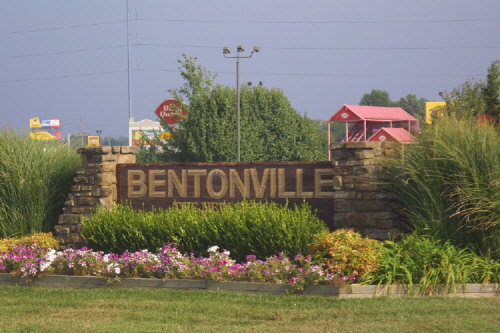
Bentonville, AR--Population 3,000 when Sam Walton started Posted by Picasa

Walton's Original 5 & Dime--Now a Museum on the Square in Bentonville Posted by Picasa

Wal-Mart’s Distribution Model

I just spent two days in Bentonville, AR, Wal-Mart’s hometown, giving a speech on BoomtownUSA, focused upon our research on the importance of small towns in the Wal-Mart distribution model. I believe that we are one the few, if only groups, that have done a complete analysis of their distribution model from a locational standpoint. And, it is their distribution and information technology models that have differentiated Wal-Mart from the competition for the past 20 years. In fact, I’ve heard it said by more than one retailing expert that Wal-Mart is an average retailer but the top of class as a supply chain manager and global buyer.

We first started researching the location of Wal-Mart’s DCs when I returned from a NAIOP conference that had focused upon their world class model and how other companies were going to copy what Wal-Mart was doing in the future. I naively raised my hand and asked, “You know I don’t know where all of the Wal-Mart DCs are located, but the ones I know are located in the agurbs®, not in the big cities where everyone else at this conference is from.” I got laughed at, which made me mad so I decided to find everyone of their locations. It wasn’t easy. Wal-Mart considered it a company secret.

We completed our first study when they had 54 DCs, they had 89 when we did the book and today are up to 109. The first study showed the concentration of DCs in towns of a population of from 5,000 to 50,000 and this most recent study has only reinforced that early finding. Of their 109, 76 (or 70%) are in towns of 5,000 to 50,000 with 20 (18%) in towns of less than 5,000.

Stay tuned as other companies learn from the Masters of the Supply Chain. It is happening in the agurbs®, not the big cities.

Friday, July 08, 2005

Illinois River Trip

It was my second river trip. My first was two years ago on the Mississippi River, from IL to MN, where we had a great time until we hit Lake Pippin with a 40 mph headwind, which kicked up huge waves, way too much for my small 20’ deck boat. One local told me that Lake Pippin is where the Mighty Mississippi meets the Great Lakes. We were humbled by the experience, humming the Titanic’s “Nearer Thy God to Thee” in the roaring waves.

This week’s trip up the Illinois River, from Peoria to Chicago was not quite as eventful as that adventure and with only 163 miles and six locks to traverses, it looked pretty simple. The weather forecast showed clear skies and mild temperatures. We thought that we would make the first leg from Peoria to Joliet in about 6 hours, doing so at a leisurely pace, and then shoot up the Des Plaines River, Chicago Ship and Sanitary Canal and finally the Chicago River. The signs on the Sanitary Canal warned us not to touch the water. Touch! The Water! No wonder we only saw one other pleasure boat on it.

The locks on the Illinois River were rebuilt in 1933 and don’t appear to have been markedly upgraded since then, compared to those on the Mississippi River. We cruised thru those in between 15 and 30 minutes. The Illinois River locks took us from an hour to three hours each. Our planned six hours turned into eleven hours, with the last six running full-out. With the sun down, running 45 mph and a slight wind in our face, it got downright cold. My crew, my wife and sons, were not happy campers.

Virtually every boater that I know suffers from “Twofootitis”, a desire to get a new boat that is two foot longer than the present one. After this trip, my crew not only doesn’t think that I need a longer boat, but questions whether we need a boat at all. Their question is, “What river is he going to put us on next?”

I was disappointed with the activity on the Illinois River compared to the Mississippi. Other than at Peru (one of my agurbs®), Peoria, Joliet and Henry, we didn’t see much to entice boaters off of the river. I think that most of the other towns are missing an opportunity to create a special “sense of place” along the river.

Family on boat on Chicago River Posted by Picasa

Shipping Changes

At one time, three Seattle shipping companies operated 20 cargo ships between WA and Alaska. When we were making our WA tour, the second of the three announced that they were closing down, leaving only Coastal Transportation with a fleet of eight boats to service the small Alaska fishing villages. Changes in the way that fish are caught and distributed directly to worldwide customers rather than being distributed through Seattle, left Western Pioneer with plenty of outbound freight but little return business.

Peter Strong, owner of Coastal, will add some of Western’s communities to his stops but, “federal shipping rules effectively prevent Coastal from continuing service to three villages in southeast Alaska.” Gustavus (population 429), Pelican (163) and Tenakee Springs (104) will be left without regular service, having to depend upon air or sporadic smaller boats.

It’s another example of the Law of Unintended Consequences. I’m sure that some law was set up years ago to protect someone, but the result in 2005 is that three small, struggling towns will be left in the lurch.

The Ports—Angeles and Townsend

I was hoping to visit an additional two of my nine Washington agurbs® on our last day, but my 17 year old sons were wanting to get to some sites in Seattle, so we only briefly drove thru Port Angeles and didn’t get to see Port Townsend. We’d already driven 1000 miles in four days, so I didn’t press them on making a 50 mile side trip.

I believe that my sons are typical of many who grow up in small town America. At 17, the world is their pearl and they can’t wait to get away from home to the “big city.” I was just like them, never contemplating ever moving back to my hometown. I was off to see the world.

But, what I’ve found in my travels and research is that there often is a homing system that kicks in when you get to be 30 that makes the old hometown appear more compelling. It doesn’t happen with everyone, but when you start to look at where you are going to settle down and raise a family, the serenity and quality of life of the old hometown doesn’t sound too bad.

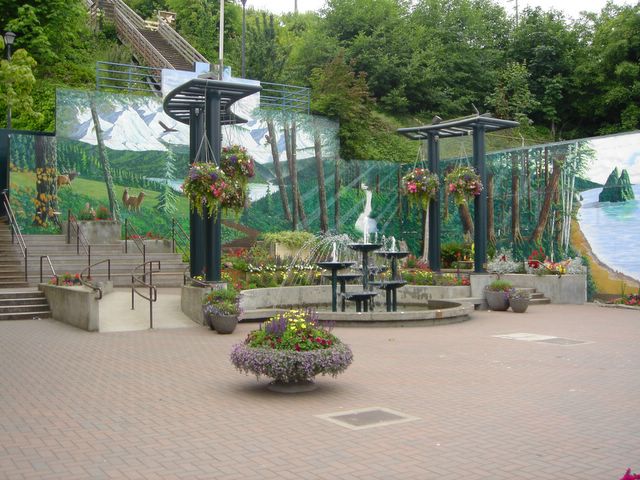
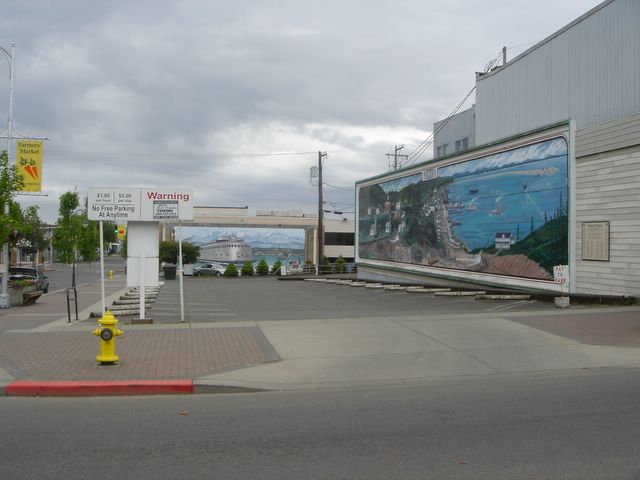
Back to my trip--Port Angeles impressed me. They’ve got a thriving downtown that sits right along the water. You could tell that the agurb® had a certain vibrancy as I drove thru it. I was particularly impressed with their murals and a small downtown park that I stopped long enough to get some pictures.

I hope to get back to both of my WA Port Agurbs®--Port Angeles and Port Townsend, in the future.

Port Angeles, WA downtown sculptures & mural Posted by Picasa

Port Angeles, WA downtown mural Posted by Picasa

Thursday, July 07, 2005

Industrial to Destination?

On my way up the coast of Washington, I stopped in Hoquiam, WA (Hoquiam, population 9,097, is an Indian word for “hungry for wood”) to talk with Mayor Jack Durney. He is a rather unique individual in that while he has been mayor of Hoquiam for a year and a half, he was previously mayor of neighboring Aberdeen 20 years ago.

Both Hoquiam and Aberdeen sit at the end of Gray’s Harbor, about 15 miles from the Pacific Ocean (25 miles by road). They were great sites for industrial operations. Timber, sawmills, paper production and ship building (Johnny Carson’s $12 million yacht was built here) were all important industries in the past. However, each has seen its better days and blue-collar towns like Hoquiam have to continue to reinvent themselves.

I asked Mayor Durney how he was approaching this challenge, “We have to figure out how to transition from a resource based economy based upon pulp and wood, into redeveloping our waterfront. I’d love to see it be a vibrant mixed use area with condos, businesses, marinas and housing developments. We’ve started a Main Street program, modeled after successful ones in Centralia, Port Townsend and Walla Walla.”
The mayor has rallied 300 local citizens for a series of strategic planning sessions on Sunday nights to establish a common vision of what Hoquiam will look like in the future. They’ve discussed the need to tie the waterfront together with a river walk, trying to get the people driving thru the town on their way to the ocean to stop by the town.

One of his comments really made sense to me, “We want to attract younger people to our community because of all of our attributes and then have them look for a job.” Mayor Durney has a vision of how he wants to transform his town, creating that special “sense of place” that I continue to search for in towns. I hope, for the sake of the citizens, that he is able to do so.

Wednesday, July 06, 2005

Giving Back & Investing in the Future

I was only in Astoria, OR for a couple of days but really came away with warm feelings for this agurb®. Everyone I met went out of their way to be helpful. Outsiders are cleared welcomed and accepted, as evidenced by my earlier posts, but what of the native Astorians?

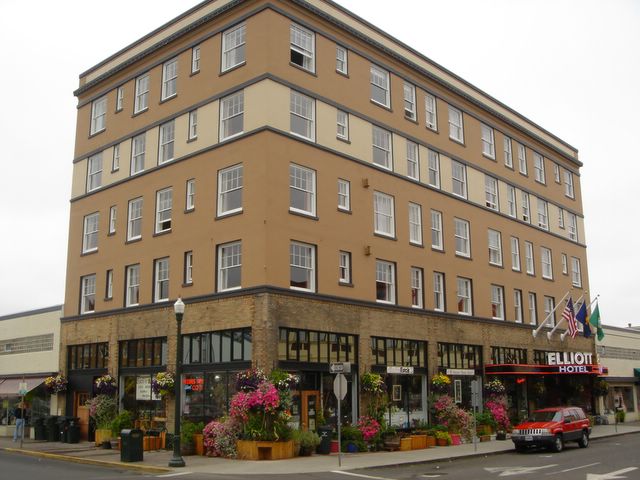
I quickly learned of Chester Trabucco’s work at renovating the Elliott Hotel. He spent several years and over $4 million to resurrect a grand old hotel to its elegant past.

Across the street is the redone Liberty Theater, a 1925 Vaudeville/motion picture palace which took four years and almost $2 million to bring back to its former opulence. Steve Forrester, local owner and publisher of The Daily Astorian newspaper, led those efforts.

Last month, the town celebrated its one millionth dollar of scholarships with a $7,000 package to a local student from the Astoria High School Scholarships, Inc., a local organization. Over 1,000 students have benefited since the program was started in 1976. Today the foundation has a corpus of $3.6 million and will benefit/invest in the youth of the community for generations into the future.

Astoria is a town with a wonderful historical past but an even more brilliant future. Put it on my list of favorites.

Hotel Elliott; Astoria, OR Posted by Picasa

Tuesday, July 05, 2005

Fireworks for 4th

The following photos were taken this weekend at our lake lot by a very accomplished photographer who is also an orthopedic surgeon, Dr. Frank Lee.

Grand finale Posted by Picasa

Neighbors at sunset Posted by Picasa

Two friends on beach Posted by Picasa

Sparklers on dock Posted by Picasa

Fireworks from boat dock Posted by Picasa

What One Woman Can Do

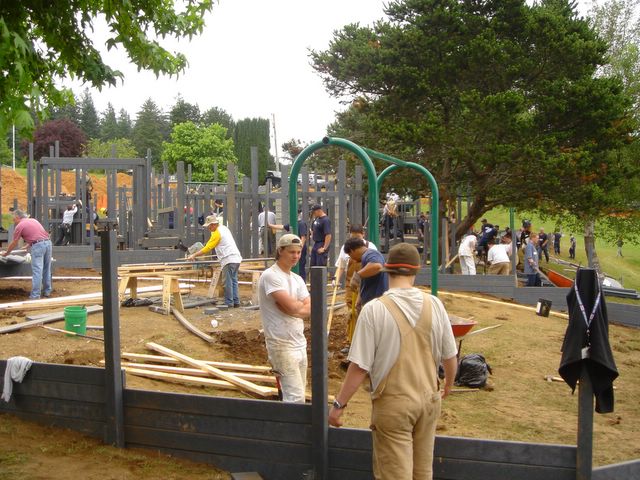
“You have to go see what is going on in our Tapiola Park” was told to me by more than one person as I toured Astoria, OR. So, after having dinner at Baked Alaska we explored the town, with hopes of finding it along with other sites. We found it just as it was getting dark and I knew as soon as I saw it that I would have to come back in the daylight to see and talk to the visionary person behind the new Tapiola Park Playground (www.tapiolapark.org).

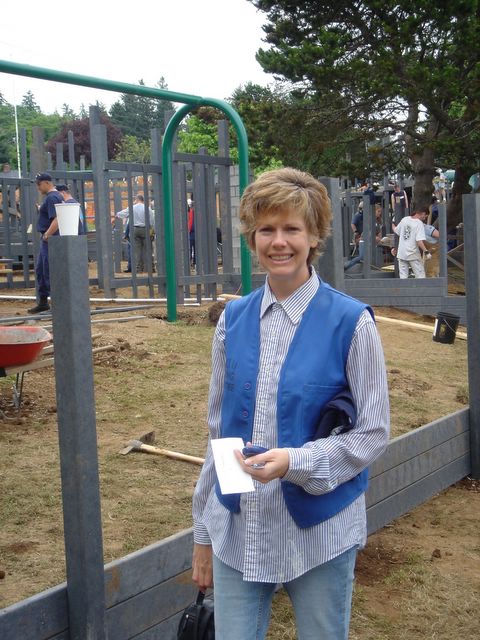
I was told to look up Wendy Berezay at the site, expecting to find one of the old-timers typical of most small towns. What I found was a surprise.

“We moved from Montana two years ago so that my husband could take over the State Farm agency. I was back home in Florence, MT when I saw a very unique playground and came back here and started talking it up to everyone I met, whether it was on the street or in the grocery store. Our old playground had collapsed here several years ago because of all of the rain and moisture we get, just rotted it away.” Wendy told me. She is the mother of 5, aged 5 to 22.

“Within a month we had about 60 people who were interested in doing something. We looked at different ways to fund it, thinking that it could either be a tourist draw or only for the community. We did a presentation to the Parks Board and the City Council in October, 2004. We had our first community wide meeting in December. We decided that we would do it all with donations, because by law, we couldn’t use any public funds or we wouldn’t be able to use volunteer labor. (Jack’s note: Another of those ridiculous laws that are used to protect a class of people to the detriment of all. Also another Law of Unintended Consequences that ends up preventing projects from taking place that could benefit a community….Ok, ok…I’m getting off of my soapbox).

“We ended up with 18 people who were willing to sacrifice a year of their life to make this project happen. We met every week or two for the past nine months with this core group. We’ve raised over $200,000 in donations and grants and had over 3,000 volunteers working to build this. If you took their labor into account, this would be a $700,000 project.”

“One of the first things we did was to get the kids involved. We sat down with them and asked them what they would want if they could have the best playground in the world. We had to discard some of their ideas like hot tubs and bungee cords, but came up with a design that reflected the historical treasures of the town. We’ve got a Liberty Theater, the trolley, a boat, the Astoria Column, a Lewis & Clark cabin, a pilot boat, a whale, the bridge, and other notable objects from Astoria. There is a climbing wall with a mural of the Peter Iredalle, a famous shipwreck near town, that will give them a feeling like they are climbing on the ship. The whole project is handicap accessible on multi-levels.”

I was inspired and awed by the sight of hundreds of volunteers working feverishly on this project in a sprint, as Wendy said, “From dirt to done in six days.” It’s great that there are so many Wendy Berezay’s in the agurbs®,

Astoria Playground Posted by Picasa

Astoria Playground  Posted by Picasa

Wendy Berezay at Astoria Playground Posted by Picasa

Monday, July 04, 2005

Happy 4th!—Let Freedom Ring!

This is one of my favorite holidays and it is not just that my sons and wife enjoy doing our own fireworks display as much as I, or that it is a great time to relax on the water at Lake Sara. I enjoy reflecting each year on what the 4th of July means and thinking of the new freedoms that have germinated around the globe in the past year.

The 4th of July was the start of a movement that would alter the world for centuries. And it is a movement that is growing in importance. Prior to July 4, 1776 the world was ruled by kings, dukes and despots. There was one way to do things…Their Way! There was no room for dissent in that Old World. If you disagreed with the ruler of the day, at best you might be thrown into a dungeon. At worst, you would lose your head.

America’s radical Declaration of Independence, which began as an idea and quickly spread into a movement, has become the dominant socio-political force in the world today. Communism, socialism and other utopian type systems have been tried and discarded because they were found to be sorely lacking. Granted, there are still dictators and despots ruining parts of the world, but their influence is quickly being eroded.

The growth of world shrinking technologies, which allow for quicker dissipation of ideas and news, like satellite television, cheaper air travel and most importantly the internet, have allowed for the rapid spread of freedom and democracy. The freedom movement is like a pebble thrown in a pool or a snowball rolling downhill. It is picking up momentum and moving to all parts of the globe. In its path, it is liberating millions of people and raising hope for those who have been repressed for generations.

The signers of the Declarations of Independence couldn’t have envisioned what this new idea of Freedom would lead to. But, if they hadn’t had the idea and determination to succeed the world would be a much different place to live in.

Let Freedom Ring!

Sunday, July 03, 2005

Baked Alaska—The Entrepreneurial Restaurateurs

“I’d always wanted to have my own restaurant and was always developing business plans and concepts when I was going thru culinary school,” was how Chef Chris Holen explained how he started his first food business in 2000. “I talked the school into letting me do a real business from one of my business plans as an internship program. So in June of 2000 we started Baked Alaska Soup Co. as a mobile soup kitchen, working out of 5x8 utility trailer which we towed behind our VW camper van. We worked the music festival circuit that summer in Alaska.”

Chris’ wife Jennifer, who he had met in Alaska several years before when they were both tour guides, chimed in, “We coined the phrase, ‘Have Soup, Will Travel’, for our operation. One thing we found out during that summer is that it is awfully hard to sell soup, when the temperature is in the 80s.” The Baked Alaska Soup Co. journey was their honeymoon.

On their drive back from Alaska, they chanced upon Astoria, OR and fell in love with the quaint town. Jennifer, “I loved it, especially the fact that it was right on the water. That was my one hope as we thought about where we would land, to be able to find a place that had lots of water.”

They kept the name Baked Alaska Soup Co. for their first restaurant, a seven table cafĂ©, that they started on the Labor Day weekend in 2000. When they started Baked Alaska (www.bakedak.com), a full service restaurant and lounge on the waterfront in 2001, they changed the name of the original cafĂ© to Half Baked Alaska. They have since sold Half Baked, but started another restaurant The Schooner Twelfth Street Bistro. Chris told me, “It was a historic old ‘dive bar’ that had been an Astoria landmark for 75 years. We opened in 2004, across the street from the restored Hotel Elliot. We serve breakfast, lunch and dinner seven days per week and also provide room service to the Hotel Elliot. More on the Hotel Elliot in a later blog.

Chris and Jennifer have thrown themselves wholeheartedly into the community. They had just done a free feed for the Tapiola Park Playground project (more on that in a future blog), started their own 4th of July Street Festival and do a Light Bite Festival with 12 other restaurants as a fundraiser for the Women’s Resource Center.

Chris and Jennifer exemplify the entrepreneurial spirit that I constantly see among the young people that I come in contact with in my travels. They are visionary, giving to their community, socially motivated and incredibly entrepreneurial. The towns that can create a special “sense of place” like Astoria will be the long term winners in the entrepreneurial sweepstakes of economic development.

Chris & Jennifer Holen and me on the balcony of the Baked Alaska (Astoria, OR) Posted by Picasa

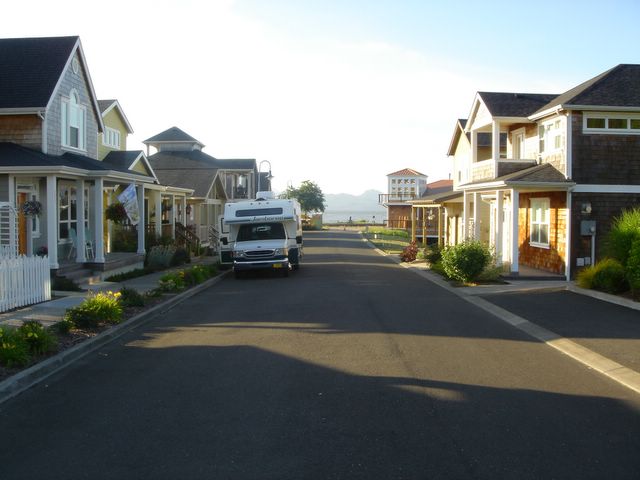
Astoria, OR Old Mill Site Posted by Picasa

Astoria, OR Old Mill Site Posted by Picasa

Astoria, OR Old Mill Site Posted by Picasa

Astoria, OR Old Mill Site Posted by Picasa

Saturday, July 02, 2005


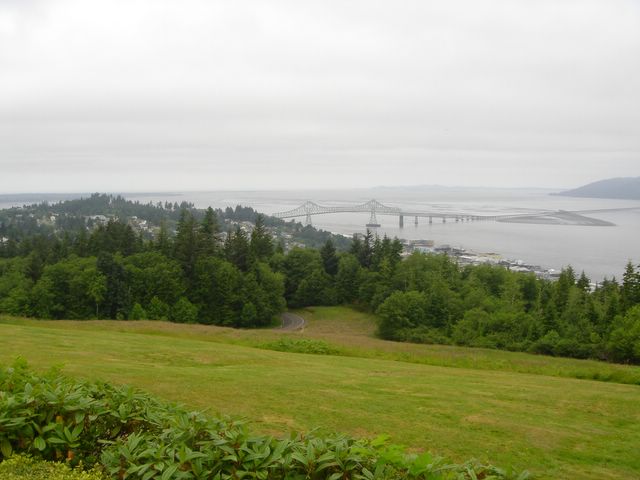
View of Astoria, OR from above Posted by Picasa

Astoria—An Amazing Agurb®

Astoria is another enchanting agurb® that I got to visit on my WA talk and tour. It is actually in OR, but is in the NW corner of the state, on the south side of the Columbia River. Lewis & Clark camped near Astoria in the winter of 2005-06 and the Pacific Fur Company, owned by America’s first multi-millionaire John Jacob Astor, built Fort Astoria in 1811, naming it for Astor. By the late 1800’s the towns salmon canneries, forest and shipping industries had turned it into the liveliest boom town between Seattle and San Francisco.

If you were a painter you couldn’t ask for a better setting. This old world town sits in rolling hills, along the Columbia River, at the mouth of the Pacific Ocean. The old, restored homes only add to its charm. It’s no wonder that in the past twenty years the following films used Astoria as a backdrop for their storylines: The Goonies; Come See the Paradise; Kindergarten Cop; Teenage Mutant Ninja Turtles III; Free Willy; and Short Circuit.

I wrote about Astoria’s local leader’s efforts to rejuvenate The Astoria Mill site, an 1870s era saw mill that shut down in 1989. The site was an ecological disaster, became a town dump and was a real eyesore sitting at the entrance to the downtown. I visited the site and took the pictures that you see here. It’s hard to believe that these new homes sit on the same spot that I wrote about in BoomtownUSA.

I found Astoria to be a very vibrant community. One couple that we sat next to at dinner told us that they hadn’t been back for two years, but were shocked with the improvements that they saw taking place in the town. People are going to quickly discover Astoria and my guess is that its best days lie in the future. There are still way too many vacancies in the downtown and the riverfront is not fully utilized, but this agurb® is a real sleeper. Get there to visit, if you are close.

Friday, July 01, 2005


Royal Purple Lavender from Lost Mountain Lavender in Sequim, WA
 Posted by Picasa

Lavender—A Cluster?

As I’ve driven several thousand miles in WA over the past year I think that I’ve seen a good number of the 300+ wineries that the state boosts of having. Washington has doubled their number of wineries in the past five years and today is the second largest wine producing state in the USA. But, there are so many wineries today that it just doesn’t fit into a niche agricultural product anymore.

Lavender, however, is another story and a small valley on the northern coast of the Olympic Peninsula has carved out a very nice niche for itself with this unique plant. In 1995 a few farmers noted that the Dungeness Valley had a similar climate to the Provence region of France, where commercial lavender is grown for oil and used in most perfumes. They experimented with the crop and showed that it could be grown successfully.

Today, 10 years later, over 30 farms raise the crop from over 160,000 plants. Each farm has had to determine their particular niche, whether it is for oil, floral bundles, sachets or some other combination. One farm, Lost Mountain Lavender (www.lostmountainlavender.com) has over 100 cultivars of the crop. Another Cedarbrook Herb Farm (www.cedarbrookherbfarm.com) was also the first herb farm in the state and has its own café. Both of these farms have their own small gift shop, as do most of the lavender farms, and virtually all offer U-pick opportunities.

Today Sequim (population 4,334) bills itself as the Lavender Capital of North America. Other websites are www.visitsun.com; www.lavendergrowers.org; and www.lavenderfestival.com.

What unique attribute, crop or other item could you develop for your town?