Saturday, April 22, 2006


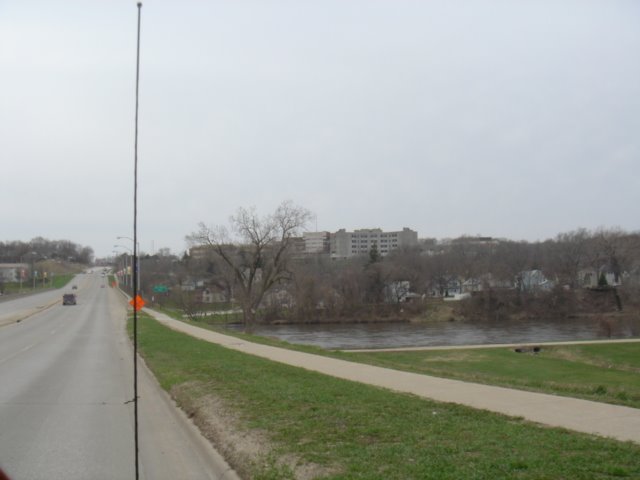
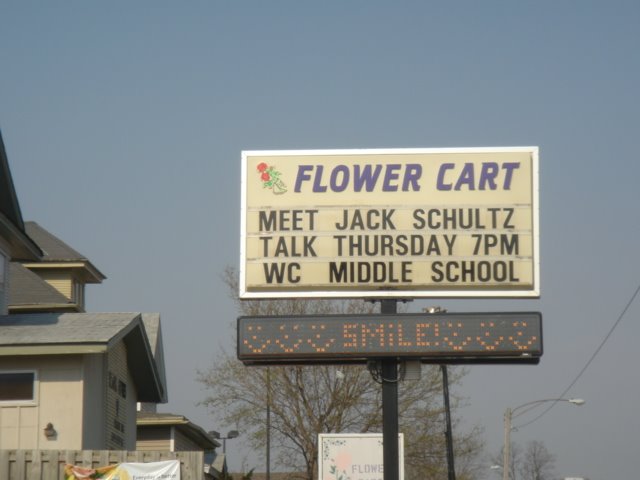
The Flower Cart Welcomes me to Town Posted by Picasa

Webster City, IA Downtown Posted by Picasa

Friday, April 21, 2006

Bring ‘Em Back: Then What?

How are we going to bring our young people back home, is a question that I get in virtually every town that I visit. Last week I met two young people who not only came back home but have developed a new organization to help make the transition a smoother one. They were on the program with me at Alliant Energy’s “Get Your Smaller Community Booming” Conference.

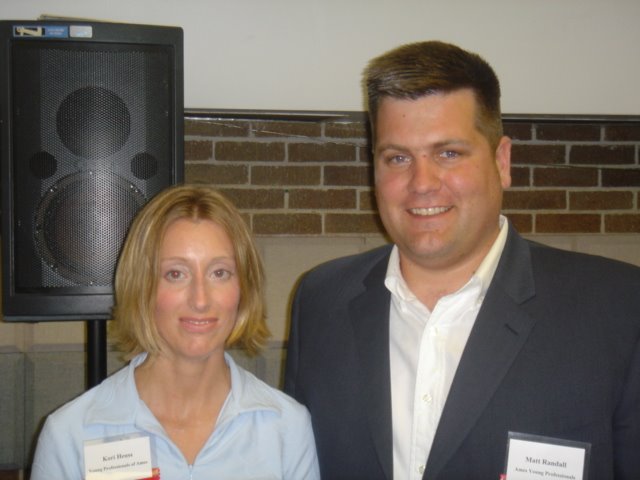
Matt Randall and Kori Heuss are both 30ish young professionals who both moved home to Ames, IA. Ames is one of my golden eagles, so I was particularly interested in their story. In 2002 they and a third individual got together to discuss trying to connect with more of the young people in the community. They grew the group to 12 and decided to go public with a concept of developing a Young Professionals Organization in the town.

They invited 100 people to their initial meeting in 2003, but word spread and over 200 showed up. Within a month they had over 175 dues paying members, aged 21 to 40, and it has grown ever since.

In 2004 they set up YPIowa (www.ypiowa.com) to help foster other Young Professionals Organizations in other towns. Already there are chapters in several other Iowa towns. I have a feeling that this is a concept that will spread throughout Iowa and to other states.

Kori Heuss & Matt Randall of Young Professionals of Ames, IA Posted by Picasa

Thursday, April 20, 2006

Entrepreneurism in Iowa

When I was in Wall Lake I met a young reporter, Doug Burns, who is the third generation of owners at the nearby Carroll Daily Times Herald. We had a great conversation about rural Iowa and afterwards he shared with me some of his writings. I especially liked a piece he did entitled: “Carroll, Iowa: A future hatchery of entrepreneurs.” Here is a part of it:

“But, like much of the rest of the state, we fall short with entrepreneurship, with ways to harness the imagination and skills of our most talented young people.

This demands attention.

We need to start early in promoting a spirit of risk-taking and connecting the ideas of the classroom to the prospects of commerce.

Our schools and businesses people should work together more closely.

They should plant the seeds of entrepreneurship early, get kids thinking about coming back to Carroll to start their own businesses and companies.

On a grand scale this could involve a sort of local entrepreneurial fund, in which bright, earnest young people from Iowa State University or the University of Iowa or Des Moines Area Community compete for start-up cash to launch small ventures here, dreaming of big things.”

I couldn’t have said it better. I’m detecting a strong undercurrent of entrepreneurial promotion taking place in Iowa. I hope that it continues to build and develop.

Wednesday, April 19, 2006

WOW in Wall Lake!!!

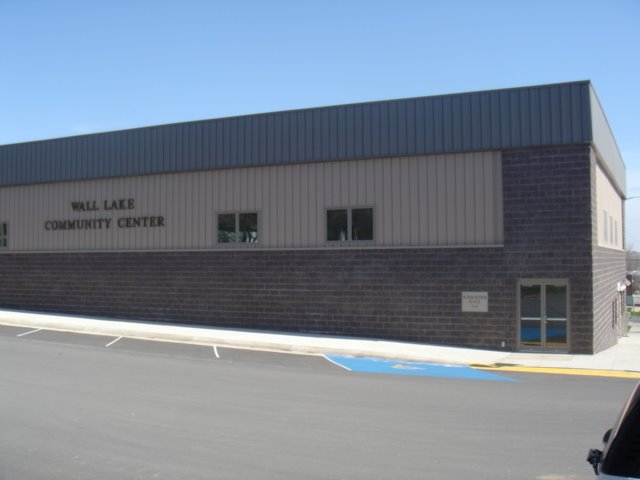
An 18,000 sf, $1.2 million community center done thru donations in a town of 800? I hadn’t heard of such a thing, so I was thrilled to get into town early for my talk so that I could tour such a town. And, my tour of Wall Lake, IA (actual population 841) didn’t disappoint me.

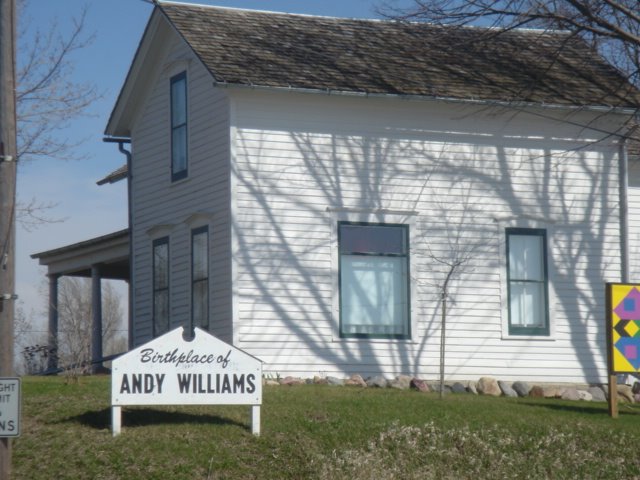
“My uncle Gus Schroeder, who was mayor for 10 years, and his wife Lil started off the campaign with a $250,000 donation but we got funds from just about everybody in town. Even Andy Williams, who was born and raised here, gave $25,000 in memory of his mom and dad. In all we raised $800,000 in donations, got $200,000 from the state and still have a note for $200,000 on the building,” Tom Schroeder, City Manager for Wall Lake told me as we toured the town. I did some quick math in my head and calculated that Chicago would have to raise over $1 billion in donations to be able to match what a town like Wall Lake did on a per capita basis. It couldn’t be done, in Chicago that is! And that is why I just love to tour towns like Wall Lake and meet the people who make towns like this what they are. They are incredible!

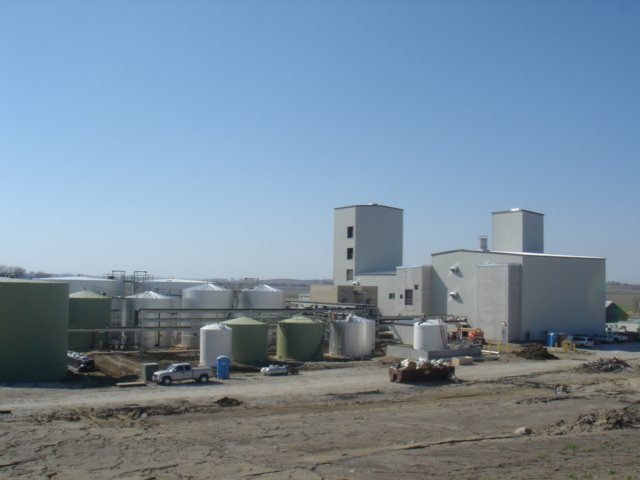
Tom wasn’t done with only the community center. He also showed me a new $50 million biodiesel plant funded by 600 area investors who raised $22 million in equity for the project in eight days. An old gravel pit is being converted into a 220 acre lake with 125 new housing units planned around it. We also visited a 70 bed nursing home that was built by the town and turned over to the churches in town to run. And, we stopped by the 660 megawatt wind turbine that was funded through a $500,000 bond issue and $250,000 Iowa ED grant. The project supplies 25% of the town’s energy needs.

One of the more colorful businesses in town that I visited was Cookies Best BBQ (www.cookiesbbq.com), which was started 30 years ago in the town. Speed Herring, who owns the business wasn’t there that day, but when people in other towns around Iowa heard that I’d been to Wall Lake, they asked about Speed. Cookies plant is a modern 105,000 sf facility that includes a test kitchen, production facility and warehouse, employing 12 people.

When 300 people showed up that night to hear me talk, I was really impressed. I couldn’t even come close to doing a calc of how many people in Chicago would have to come hear me talk to get to the ratio of people interested in their town and how they could make it better.

Wow!!! Wall Lake blew me away!

New Wall Lake Community Building Posted by Picasa

Tom Schroeder at Cookies Test Kitchen Posted by Picasa

Wall Lake Windmill Posted by Picasa

New Biodiesel Plant Under Construction in Wall Lake, IA Posted by Picasa

Andy Williams Birthplace in Wall Lake, IA Posted by Picasa

Tuesday, April 18, 2006

Branding Fort Dodge

“The Community Action Network was set up by Trinity Regional Medical Center, the local hospital, which takes 10% of its net income each year to reinvest into the town,” Randy Kuhlman head of the Network gave me a tour of Fort Dodge, IA (population 25,136) prior to my talk. They are helping build replicas of Wrigley Field, Fenway, Dodger Stadium and Yankee Stadium in their local park where the state softball championships are held.

Fort Dodge was an old meat packing town with a reputation for being a rough and tough blue collar town. The last meat packing plant closed their doors 20 years ago, but the reputation lingers.

Today Fort Dodge is going through a transition into a regional economic powerhouse. Newly elected Mayor Terry Lutz was elected with almost 80% of the vote over the incumbent mayor on a platform of creating jobs and opportunities, transitioning the town into the information age. He also has plans to develop the old industrial area along the Des Moines River into a green space.

Fort Dodge was chosen as an All-American City in 2001, one of only 10 in the USA to win that award each year. The National Civic League looks at the quality of life in the town and the way that reinvestment is taking place in making their decision.
Fort Dodge has great potential if you get beyond its old reputation. A branding program for the city might work wonders, because as I’ve told other towns, “If you don’t establish your own brand, someone else will establish it for you and you might not like what they brand you.”

Trinty Regional Medical Center, up on the hill Posted by Picasa

Ft. Dodge Industrial area Posted by Picasa

Monday, April 17, 2006

Do We Really Need a 9 Million Word Tax Code?

Today is Tax Day in the USA. Because the 15th fell on a Saturday, we all got a two day extension on filing our taxes. Whoo-boy! That really got my blood pumping!

No one on earth knows what is in the federal tax code. Its vast complexity plagues the system, and is a burden the tax payers are unnecessarily bearing.

Steve Forbes, testifying before the President’s Advisory Panel on Federal Tax Reform, put the federal tax code in perspective: “The Gettysburg Address, which defined the American nation, is 272 words in length. Our Declaration of Independence is some 1,300 words. The Bible, which spans several thousand years of human history, is 773,000 words. But the federal tax code, with all of its attendant rules and regulations, is 9 million words and rising.

Since the last attempt at tax simplification was made in 1986 the code has been amended 14,000 times and grown by 3 million words. Today a typical taxpayers filing a regular Form 1040 will spend 26 hours and 48 minutes annum completing his return, that’s up 57% from 17 hours and 7 minutes spent filing in 1988. Americans are spending 6.6 billion hours preparing their tax forms. That’s the equivalent of 3.3 million full times jobs are squandered on tax compliance! Does anyone else see a serious inefficiency here? Think of the lost productivity!

And it’s not just the everyday citizens that are confounded by the tax code. Tax professionals are often confused by the metamorphosing regulations. Isn’t there a way that the people can be relieved of this headache?

Sunday, April 16, 2006

Roller Coaster Auction

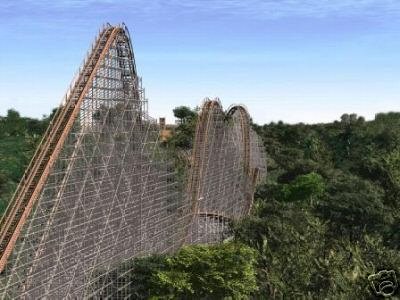
Santa Claus, IN (population 2,041) is one of my favorite towns. Holiday World, a family owned amusement park is celebrating their 60th anniversary this year. The new season opens on May 6th with the inauguration of the world’s top “air time” wooden roller coaster. Riders will experience 24.2 seconds of weightlessness during the 1.2 mile ride. The coaster will also hold the U. S. record for the steepest drop on a wooden coaster, at 66 degrees from the 173-foot-tall peak.

Holiday World is auctioning off 28 rides on The Voyage for one hour before the park opens to the public. Current bidding is at $150/ticket. Click here to go to the bidding which ends on Wednesday.

The Voyage Roller Coaster at Holiday World in Santa Claus, IN Posted by Picasa

Another Southern Auto Plant

The new Kia Automotive plant announced for West Point, GA (population 3,382) took the assemblage of 36 parcels of land totaling 2,194 acres adjacent to Interstate 85. West Point, sits right on the AL state line in a county of 62,000. The plant is projected to be making 300,000 cars per year in the five million sf under roof, equivalent to 300 football fields.

Already six suppliers have agreements to move into the area and others are expected to make similar announcements. It is those supplier plants that will help to transform the area around West Point. The growth of southern auto plants are transforming that region for the better.

Saturday, April 15, 2006

Why Not an Arts Map?

OK has tourist maps for Route 66, The Great Plains Trail and the Wind Power Trail. The state has almost 400 miles of the original Route 66 still drivable, more than any other state. The Great Plains Trail highlights 13 driving loops in western OK that overflow with birds and wildlife. With birding being the fastest growing spectator sport in the USA, the Great Plains Trail map also makes a lot of sense. The Wind Power Trail is a cooperative effort of 24 Chambers and ED groups in OK and TX. It takes you to the National Weather Service’s Storm Prediction Center, wind farms, vintage windmill collections, a wind-turbine factory and some wonderful small towns. I plan to take the trip on one of my visits to my son at OU next year.

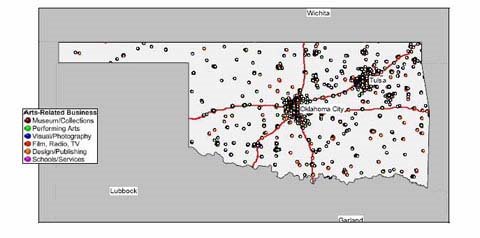
When Randy Cohen of the Americans for the Arts (www.artsusa.org) showed a map which highlighted all of the arts related businesses in the state, I wondered why a similar tourist map isn’t done in OK for these arts businesses. Wouldn’t it be as much of a draw as a map of birds, old roads and windmills?

OK Map of Arts-Related Businesses Posted by Picasa

Friday, April 14, 2006

Economic Impact of the Arts

“There are 4,193 arts-related businesses in the state of Oklahoma, which employ 22,724 people.” Randy Cohen, VP of Research for the Americans for the Arts (www.artsusa.org), was one of the speakers at the Oklahoma Center for Nonprofits Leadership Education and Arts Development Conference.

Cohen has meticulously documented the arts-centric businesses like museums, symphonies, theaters, architects and other creative industries having developed studies by state, county and even congressional district. He also has an Arts and Economic Prosperity Calculator that can show the impact of an organization upon a town or county.

“We measured the impact of the counties that were impacted by Katrina. We found that there were 24,003 arts-related businesses with 108,296 people that were impacted by the hurricane.”

As the arts become a more important economic development tool, Cohen’s site is one that you might want to bookmark.

Thursday, April 13, 2006

Long Haired Fashion Photographer to Mayor?

“Boy, you’re gonna have to cut that hair of yours,” was what Alex Damon’s father-in-law told him in his western Oklahoman drawl when Alex decided to move to Cordell, OK (population 2,867). “And, you can’t be wearing that jewelry that you wear.”

Alex was a fashion photographer who was semi-retired in the Virgin Islands. His wife, who was born and raised in OK, talked him into moving the family (children ages 5, 7 and 11) closer to her family in the summer of 2002. He was a speaker prior to my talk at the Oklahoma Center for Nonprofits Leadership Education and Arts Development Conference.

When Alex was lamenting to a friend that we was moving to rural Oklahoma, his friend gave him some wise advice, “Make it what you want it to be.” Alex went with an open mind, starting a small photography studio and art gallery (www.damonphotographics.com) in the town 100 miles west of Oklahoma City. Alex related to the group, “I went there with an attitude of ‘what the hell, it’s only Cordell. I’d been open for two months when someone called and wanted me to fill in for a vacant seat on the town council. The town was facing state foreclosure because we were in such bad financial shape. I said ‘what the hell, it’s only Cordell.’ When the city clerk, city manager and mayor all resigned they choose me as acting mayor. I like to think that I did such a good job that when I ran for the position that no one else ran against me, but it could have been because no one else wanted the job.”

Within a short period of time he got the city finances turned around. The town is hoping to utilize the assets of their historic downtown to turn it into an arts based economy. Mayor Damon has Arts Space out of Minneapolis looking at assisting him with the establishment of artist’s lofts. Already, he has two Texas artists and one Oklahoman who have agreed to move to the town if he gets the project established.

To assist in the quality of life of the town, Mayor Damon set up a recreational board which through private fundraising and public funding is in the process of building a nine-hole municipal golf course. They also are beginning a ½ mile bike and pedestrian trail that will connect all of the outdoor facilities in town and that he hopes to grow regionally. “We’ve also got a great renovated theater. Now we need to bring in a restaurant, so that when people come to it, we keep them in town a bit longer.”

His gallery has continued to grow and he is in the process of moving into an old car dealership in the downtown that is four times larger than where he started. He has big ideas of other changes that he hopes to make.

Alex Damon is one of the best examples of what one person can do in a town. He’s only been in Cordell for 3 ½ years, but he has developed a shared vision of how life could be better for the town. He told me, “I don’t want this to be known as where a town used to be. We’ve got to make it better.” He won the Governor’s Arts Award for the State of Oklahoma in 2005 and I’m guessing that you are going to be hearing a lot more about him. Be sure to stop in Cordell, if you’re ever driving on I-40 in western OK.
Cordell Mayor's Alex Damon Self Portrait Posted by Picasa

Cordell's downtown theater Posted by Picasa

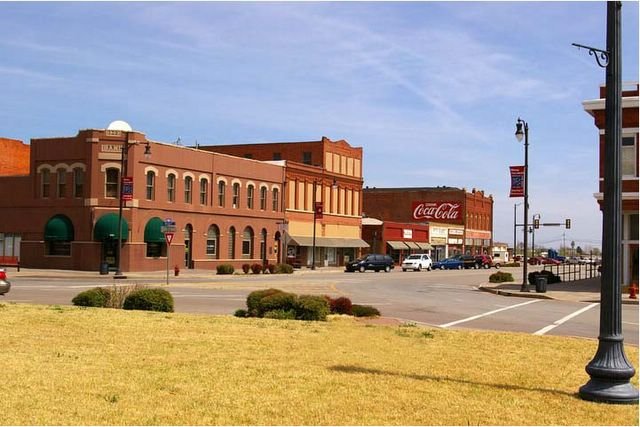
Downtown: 1st Building is bank building which is in use; 2nd building is boarded up hotel and 3rd building (coca cola sign) is old opera house Posted by Picasa

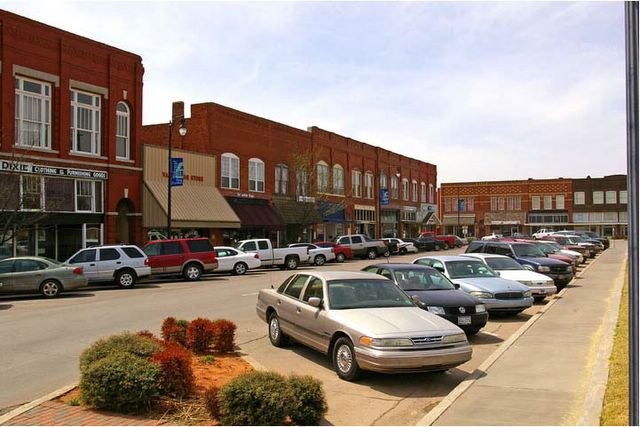
Downtown Cordell, OK Posted by Picasa

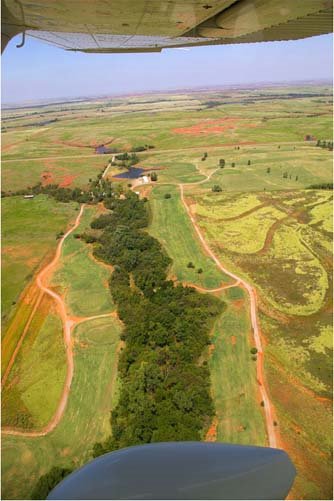
Site of future Cordell, OK golf course Posted by Picasa

Wednesday, April 12, 2006

Homegrown

One of the trends that I’m following as I travel around the USA is the growth in homegrown produce. One of the best guides that I’ve seen identifying these producers I found in my trip to Mount Vernon, OH. The Rural Life Center at Kenyon College has a 40 page bound booklet with maps and descriptions of 44 different producers in the county.

It’s something that you might want to think of doing in your town.

Tuesday, April 11, 2006

Community Foundations

If there was only one thing that I could help start in every town that I visit, it would be a community foundation. As I’ve traveled around the USA, it has singularly been the one common denominator that I’ve seen which has most positively impacted ever town which has one. I was not disappointed by what I saw in Mount Vernon, OH.

“We are celebrating our 61st year as a foundation. We are up to $28 million in assets.” Sam Barone, President of The Community Foundation of Mount Vernon and Knox County was telling me about the foundation. “Last year we received contributions of more than $1.5 million from over 300 different donors. And, we gave away over $600,000 in grants.”

The foundation was set up in 1944 by the president of the Cooper-Bessemer Company, a Fortune 500 company that started and was headquartered in Mount Vernon. Assets grew to $111,000 in the first 10 years of existence and only passed the $1 million mark in 1974, but since then they’ve more than doubled each decade.

Today the foundation has over 200 separate funds in areas such as: arts and humanities; community improvement; designated funds; education; health and wellness; human and social services; spiritual growth; youth enrichment; donor-advised; scholarships; and unrestricted funds.

There is going to be a monumental wealth transfer taking place in this country over the next decade as the “greatest generation” passes on. If you aren’t capturing a small percentage (5 to 10%) of that transfer for the long term betterment of your community, you are missing an excellent chance to help transform your town. If you don’t have a community foundation, make a pledge to set one up in 2006. You’ll feel good that you did, but your grandchildren will be in awe. It just takes time and generous giving.

Monday, April 10, 2006


Downtown Mount Vernon, OH Posted by Picasa

First-Knox Bank in Mount Vernon, OH Posted by Picasa

Constantly Evolving

“The horse and buggy was still the primary mode of transportation, and the Board looked upon loan applications with great misgivings if the applicant owned an automobile,” was a line that caught my eye as I was reading the history of First-Knox National Bank, which had brought me into Mount Vernon, OH (population 14,375) for their annual Business Summit. The bank was founded in 1847 and has evolved greatly over that period of time, just as a town has to evolve and change.

I was reminded of a friend’s story that his lead bank wouldn’t finance his airplane or anyone’s airplane because the Chairman thought they were an extravagant luxury. The loan officer ended up financing the plane, hiding it as a loan for farm equipment, which was acceptable to the Chairman. Or, the bank that wouldn’t make a loan to young Bill Gates because they couldn’t figure out how to collateralize this thing that he called “software”, when Micro Soft was a two worded company in Alburqueque.

Mount Vernon impressed me as a town that has evolved from a farming and trading town. Today it is a wonderfully diversified community with a strong base in manufacturing, education and construction. It ranks in the top 10 counties in the state in the later 2 categories and number 27 in manufacturing employment, out of the 88 counties in the state.

Gordie Yance and Curt Cree from the bank gave me a great tour of the community’s many assets including Kenyon College and Mount Vernon Nazarene University. They obviously are very proud of their hometown and continue to make substantial investments in the community for its long term health. Having such a bank in a town is critical for long term success.

Sunday, April 09, 2006

Industrial Tax Abatements

Two weeks ago I was in Grand Haven, MI (population 11,168) where the local newspaper was reporting upon the work of two college professors whose research showed that tax abatements didn’t work in distressed central cities. Hello! I’m not sure that anything would work in trying to bring industrial jobs back to inner cities. The advantages of the agurbs® are so far superior!

Joy Gaasch sent me an op-ed article that was done by the heads of the five taxing bodies in the county. Joy wrote, “Your presentation in Grand Haven really stimulated the response.” Here is part of their op-ed.

‘Is this fair? Let’s start by examining property taxes paid versus community services received. It is an undisputed fact that commercial and industrial businesses pay more in property taxes than are received in services. This is illustrated by the following graph that shows that for every $1 in property taxes paid, industrial and commercial businesses receive $0.27 in services. In comparison, for every $1 in property taxes received, residential properties receive $1.17 in services.

This is why purely “bedroom” communities have a difficult time prospering and the reason that most cities and townships seek a balanced mix between residential and business uses.

It is also undisputed that industrial jobs create additional employment for the Northwest Ottawa region, every high-wage industrial job creates 2.75 additional jobs. This level of job creation doesn’t occur with retail jobs, professional or office jobs, government jobs, education jobs or health care jobs.

The positive influence of industrial tax abatements in this region of Ottawa County is one of the reasons we are blessed with 169 manufacturers that provide employment to about 16,000 workers. This level of manufacturing is much higher than any other region in Michigan.’

Seven Millionth Patent!

It took one tenth of the time to get from 6 million to 7 million as it took to get to the first million patents in the U. S. Patent Office. Patent number 7 million was issued to a DuPont senior researcher for “polysaccharide fibers, a biodegradable fiber that has cotton-like properties used for textiles.

It took from 1836 to 1911 to get to 1 million patents, but only seven years to go from 6 to 7 million. Prior to 1836 patents weren’t numbered and it is estimated that there were approximately 10,000 patents issued from the first one in 1790 to 1836.

In 1899, Charles H. Duell, former Commissioner of the U. S. Patent Office stated, “Everything that can be invented has been invented.” How wrong he was!

The USA continues to be a technological innovator. My guess is that patent number 8 million will happen in less time than number 7 million.

Saturday, April 08, 2006

CA Fleeing

Another CA company is moving their headquarters to the Midwest. In March Festool, a German-based power tool manufacturer, announced that they were also moving their DC and national training center to Lebanon, IN. The company invented the hand-held orbital sander. It plans to add an assembly line and production facility as part of its longer term expansion plans.

Shortly after writing this blog, I was reading the Mooresville, NC Tribune and learned of Hybrid Technologies, Inc. moving their headquarters to that charming town which bills itself as “Race City USA” and has 49 NASCAR race teams that call it home.

This is the third CA company that I’ve learned of in the past three weeks that has announced plans to leave high cost CA for the Midwest and one to NC. I wonder if this isn’t a longer term trend that we are witnessing. What do you think?

Friday, April 07, 2006

Tree Stand R & D?

“We’re doing a $1.5 million R&D Center for outdoor products, including our tree stands,” John Waller, who started Summit Tree Stands in Decatur, AL (population 53,929) 25 years ago, was telling me about their recent announcement. “I was a hunter and couldn’t find anything that gave me the comfort, support or camouflaging that I wanted. I was working for another company in their engineering department, but worked on designing and selling my units on the weekends. It was just my wife and I doing everything.”

Today Summit Tree Stands sells 70,000 to 90,000 stands per year, producing a superior product through advanced manufacturing technology. Waller told me, “We have been able to maintain a cost advantage when you compare us to foreign competition from China because of automation.”

One of the major trends that I’m following is the growth of interest in recreational land. The changes that are occurring in this industry driven by aging baby boomers are exciting for rural America. Seeing companies like Summit making an investment in R&D that is aimed squarely at this demographic change is another sign of what lies ahead.

Back in Commission

It is very frustrating when you are out of touch, like I was for the past two days. My computer crashed and it was a hopeless feeling. I’ll have some great blogs on my travels of this week in OH and OK, once I collect my notes and have some time to write them up starting this weekend. I’m just trying to catch up with the many emails that I’m way behind on due to the computer problems. I want to offer my apologies to anyone who hasn’t received an email response yet. I’m working on it!

Thursday, April 06, 2006

Out of Commission

Today I'm in Oklahoma. Tulsa to be exact and unfortunately modern technology has exploded in my face. My computer crashed early this morning and I feel like I have both my hands tied behind my back. I can't receive or send e-mail, so I am having my staff at Boomtown Institute post this to make you aware of my dilemma. Now you know, if you can't e-mail me it's not because I don't want to reply (I always do), it's because I can't. Hopefully I'll be up in the next day or two and we can correspond then. Thanks for your patience.

Wednesday, April 05, 2006

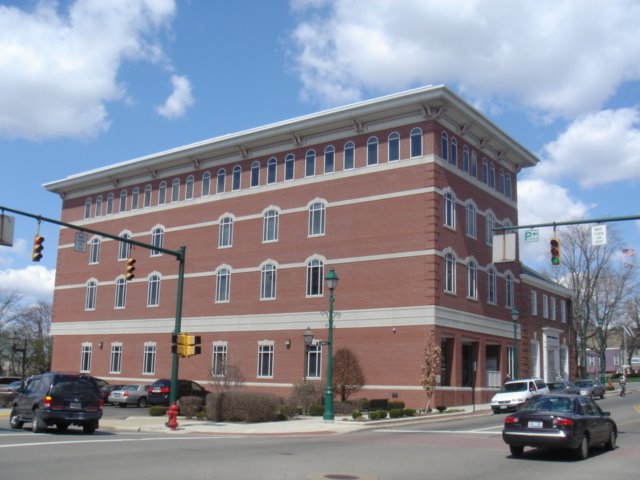
Downtown Durango

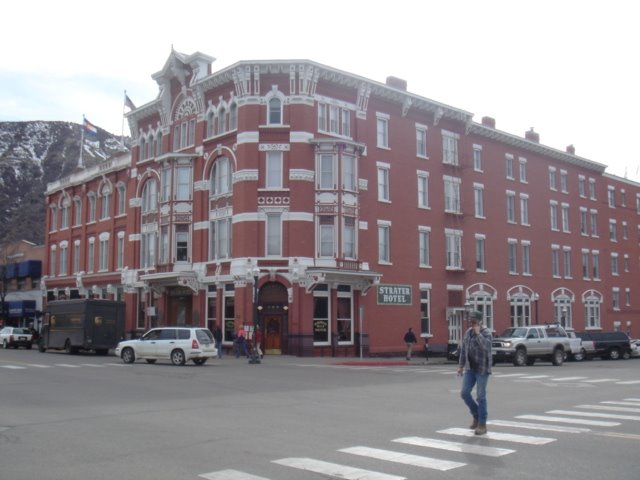
Durango, CO (population 13,922) was founded as a railroad town in 1880 and quickly grew as a regional hub for the silver and gold mining region. Within a decade the town enjoyed the first electric lights in the state, streetcars, three newspapers and five rail lines that connected in the town. When the minerals were depleted, the town went into a slow decline but the old grand buildings on Main Street remained.

Today, Durango is going thru a renaissance as a regional center for recreation, skiing, shopping, medical, etc. The downtown is one of the nicer ones that I’ve seen and helps to make Durango a special place. It is very deserving of being one of my top 100 agurbs®.

Downtown Durango, CO Posted by Picasa

Strater Hotel; Durango, CO Posted by Picasa

Tuesday, April 04, 2006

Come Back Home

The Pagosa Springs Sun weekly newspaper had a full page article this week on four families that had recently moved back to the town of 1,591. These young people, in their late 20s and 30s, all felt the tug of their hometown and decided to leave big city jobs to return home to family and friends to raise families.

One of the challenges of a place like Pagosa Springs, CO is finding jobs and opportunities for these young people. With 59% of the homes owned as second homes, housing prices are escalating and unless high paying jobs can be found for the area, many of the locals can get priced out of the local housing market.

Bart Mitchell’s charge as head of ED for the county is to find the high tech, high paying jobs that a town like Pagosa Springs needs for the future. He recently landed a toy distributor that will bring 10 jobs at an average salary of $43,000 to the town. Another company, Parelli Natural Horsemanship, moved their headquarters from FL to a ranch on the outskirts of town, creating 30 new jobs. Pat and Linda Parelli bring in horses and owners from around the world for their unique horse and rider training methods.

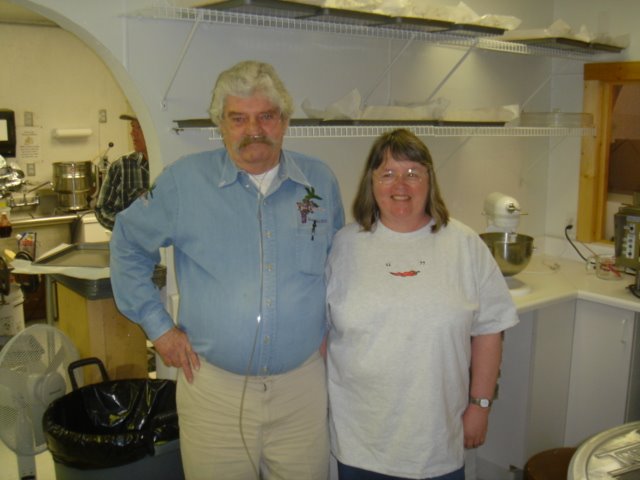
Bill Goddard started a restaurant in 1998 after running a produce stand. His homemade jams, jellies and candies were a big hit and he set up The Choke Cherry Tree (www.thechokecherrytree.com) with five employees. After I tasted his product I bought almost $100 of products. The Key Lime Fudge and Carmel with Nuts were both hits at home.

Places like Pagosa Springs, with its natural beauty and tranquil setting, are going to be easy sells for entrepreneurial businesses. They are going to become meccas for creative, artistic individuals and businesses.

Bill Goddard & Connie Bunte owners of Choke Cherry Tree Posted by Picasa

Choke Cherry Tree Offerings Posted by Picasa

Monday, April 03, 2006

Organic Life Force Changing Downtown

An organic life force is changing the face of downtown. It’s not poison ivy.
That life force is called tax increment financing — TIF.
To see the magic of TIF, go to South Fifth Street and Mary, where sidewalks, brick pavers, fencing and assorted improvements have helped change the look of a once-dead part of downtown.

This was the start of an editorial in the Waco, TX Tribune on one of the least understood ways to encourage economic development. Check out the full editorial here.

Telecommuting Heaven

I still find it hard to believe that people pay me to travel around the country, touring their towns. Friday was one of those days when I was sure glad that they did.

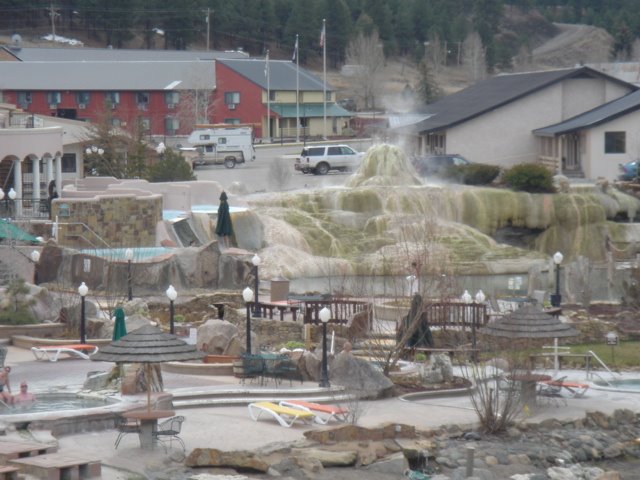
I was in Pagosa Springs, CO (population 1,591), one of my 397 agurbs®, which sits 7,000 above sea level at the base of the Continental Divide at 11,000 feet. I had been there 20 years ago when I’d skied at nearby Wolf Creek. The whole county (Archuleta County), which is larger in size than Rhode Island, only had a population of 3,664 in 1980 but has grown to 11,886 today. It is being rapidly discovered by Americans looking for a quieter, more peaceful lifestyle. And, wanting to live in the midst of the incredible beauty that surrounds Pagosa Springs!

As I introduced myself around the room prior to my talk, I was struck by the number of people who told me that they had moved to Pagosa Springs because they could work remotely and live wherever they wanted to. It was probably the largest concentration of telecommuters that I’ve seen as I’ve traveled around the USA.

Bart Mitchell, Executive Director of the Archuleta ED Association, was typical of the people that I met. Bart worked for GE in their medical devices group in Milwaukee and when he was promoted to running their Mergers & Acquisitions, which involved a lot of international travel, he decided to move his family to rural Colorado. When his group was sold and he was asked to move back to Milwaukee to run one of the GE business units, he declined and decided to stay in Pagosa Springs.

My seatmate on the plane from Denver to Durango was returning from his monthly visit to Chicago. He designs kitchen faucets from his home office in the Rockies, sending CAD-drawings back and forth via a broadband connection. His wife designs and sells greeting cards from their home. They moved from southern California several years ago.

Places like Pagosa Springs are undiscovered wonderlands that are going to be attracting more of these knowledge workers in the future.

The springs of Pagosa Springs, CO Posted by Picasa

Sunday, April 02, 2006

Promoting Rural Iowa

“We have many of the right ingredients to make Mitchell County one of the fastest growing counties in Iowa,” was in an email I received from Stan Walk a local county supervisor. I’ve been to Mitchell County, IA (population 10,970) many times and was impressed with their innovative approach to get the word out on the positive things in the county. Everyone today wears t-shirts and their promotion of using this rather low cost marketing vehicle to generate interest in the county is to be applauded.

Investors in and around Mitchell County recently raised $63 million in equity from 400 investors for a $150 million ethanol plant in only one day! The 100 million gallon plant will be built nine miles north of St. Ansgar, near the MN border. The plant will employ 45, processing 36 million bushels of corn annually.

It’s great to see small, rural counties like Mitchell County continuing to promote their attributes and helping to create jobs.

Janet Grunloh, Sarah Robins & Trisha Mason modeling the Mitchell Co, IA T-shirts Posted by Picasa

Company Town Tidbit

Last week’s Agurban, our weekly ezine on rural ED, featured Port Gamble, WA being recreated from a company town into an entrepreneurial town. Linda Fettig, with the state of NE in ED, sent me the following email:

“I just wanted to let you know that my parents were married in Port Gamble - my mother was raised there and I was raised in the same county (Poulsbo). Here is a little known twist to Port Gamble's history. Your house in town was assigned by the husband's job at the mill - get a promotion, get a bigger house. When my Mom and family (12 children) lived there the town boasted a hospital, company store and a beautiful hotel that was still standing when I was a girl. When my grandfather passed away from cancer, there were still seven children at home. My grandmother literally had to leave town because all the houses were owned by the mill and assigned to job holders. The town was in serious decline in the 60s and many of the beautiful homes and buildings including the school and hotel were torn down. Luckily, someone had the foresight to preserve some of it and it has become a magnet for entrepreneurs. The town also had a very odd custom - men in town were known by their first name but the wives were simply called by their married last name - no Mrs. in front. So you and your wife would be Jack and Schultz. My grandparents were Dale and Fullerton and my grandmother's best friends were Guy and Hayes. Never found that custom in any other community I worked in. Just thought you might enjoy this tidbit of history. See you on the conference trail. Linda”